These projects showcase how I have helped my team using unconventional data sources.
As a product marketing analyst, a large portion of my role involves looking at customer data. This boils down to two processes: Understanding market trends and customer behavior
I was able to combine internal server data, salesforce records, and google analytics data with the help of agentic AI into Google Data studio. Despite HydroPoint not having a dedicated CRM system that integrates with our platform, I can help deliver insights about how our customers are using our product.
This data helps our team target which features to develop when we want to increase our market presence in certain industries. It also helps us identify which features aren't being used, and adjust training and marketing accordingly. It has been instrumental in proving that my efforts around product launches have been successful.
Getting reliable data about competitors can be difficult in our industry, and often relies on rumors and input from the sales team. Using Agentic AI, I created a monthly competitor newsletter that monitors HydroPoint's biggest threats and informs the teams. The agent searches specific product news pages and social media channels to find new product releases or partnerships. It also analyzes market trends to see if key industries will be impacted by events or legislation. Since the newsletter's launch, our team hasn't been caught unprepared for any problems in our market.
Campaigns I planned, shot, shipped and measured — from three product lines at HydroPoint down to a one-man repair shop.
{{ l.stat }}
{{ l.statLabel }}
HydroPoint is at it's core an IOT company with an irrigation twist. Our smart irrigation controllers may sit unaltered at a site for years, but the software that runs them is constantly evolving. Prior to my hiring, feature launches often went un-noticed by our users. This is doubly complicated because our customers are often not our users, and the user base ranges wildly in skill level.
Since beginning my role, I have helped launch multiple Software updates across three distinct product lines. These range from banal firmware updates to features that users have been asking about for years. I create the positioning for the launches with the help of the product team, train our sales teams on the features, and work with marketing on creating content. I often write product news posts, email campaigns, and create graphics for releases. This is all tracked with the Product Marketing Dashboard to ensure users are seeing the campaigns and adopting the features. Some notable achievements
When I started at HydroPoint Data Systems was developing a Saas service for a large company, who suddenly lost interest in the project. This left a team with a lack of direction on where to take the project, which focused on mapping and surveying irrigation sites.
I knew we had to pivot, but knew we would need data to back up our decisions. By cross-referencing customer mapping trends in our other platforms with salesforce data, I helped identify which of our markets would be the most likely to adopt the new platform. I also helped facilitate interviews with different key stakeholders to determine their needs.
We quickly learned that our initial target industry may be difficult for our first market release. The platform was still in it's infancy, and national retail chains will want bespoke integrations that our other customers won't need. I helped our team create a staged go-to-market strategy that ensured our release would be targeted towards our accounts that would resonate the most with the product. Once their needs are met and we have a strong foundation, we will be able to compete with more enterprise-level solutions.
Since starting on the project, I have helped design workflows, vetted feature development schedules, built training systems, outlined messaging, created sales pitch decks, video overviews, and website edits. If you see anything related to SiteManager, I have influenced the content greatly.
Find the bottleneck, kill it, spend the reclaimed hours on work that actually needs a human. Every row below is a process I rebuilt.
I worked with one of our developers to create a sales deck generator that is adaptable to any customer.
HydroPoint's sales process is both direct and via distribution, and deals often start with a presentation on what our company can do. I was tasked with updating our pitch decks across three product lines. However, these decks need to not only be easy to update, they also need to resonate with customers (duh). After a tempest of brainstorming, I arrived at the following system:
The sales rep picks the product line, and the industry of the lead. However, the sales team will rarely know which personas are going to be in the room, and need to adjust accordingly. For example, a sustainability persona will care about overall water savings, whereas a operations manager will care about technical features.
The new system allows our team to adjust presentations on the fly, clicking through a ”Choose your Adventure” style of presentation. The system has helped empower our sales team by taking them out of PowerPoint and putting them in the field.
When I started at HydropPoint, our team would post their success stories in a central Teams chat to show off. However, this data had to be manually imported into Excel, and it was perfect grunt work for a new hire. Instead of copying and pasting hundreds of messages, I used Microsoft Power BI to automate uploads. The system connects to teams, filters messages, and uploads the message to an Excel sheet, images included. I also helped the team devise a new reporting system that standardized units across reports.
This system lets our marketing team easily pick and choose success stories when communicating with our clients, and helps our team showcase our wins both internally and externally.
Irrigation controllers are often handled by people who, for all their best intentions, know little about the system they are using. Onboarding field users is tricky, because they are in a rush to finish a job and don't need to know everything ASAP. However, manuals often sit in the field for years without updates. While hardware may not change, software is a different story.
This project began as a simple check for extra manual pages that could be removed, and ended up uncovering multiple systemic issues. I interviewed multiple customers, and they all had different feedback: all of it was negative. Many never read the manuals, and some even ripped them out of the controllers. What's worse is that the bags they sit in would shatter in the cold and melt in the heat.
Working with customers, engineering, and the product team I helped implement and develop a new solution for our users. I completed various rounds of prototypes and thorough environmental testing to ensure the materials hold up to field conditions.
We eventually settled on completely restructuring our knowledge base for quicker field troubleshooting and access to bi-lingual articles. We ended up using simple laminated sheets on a tag secured to the controller with industrial strength velcro. This helps give users easy access to basic info, and remind them where to get up-to-date walkthroughs.
This may seem like a really small project, but I am incredibly proud of how it's gone. I have managed the entire process for the project, from ideation to production, and it helped me become familiar with the product development process that precedes my work. It has been incredibly gratifying to see how excited our partners are that their team can quickly get the information they need, no matter their skill level. A nice bonus is that I can confidently say I know more about Velcro than anyone I will ever meet.
When I started at Rogall and Co. their blog production process required manually researching and creating SEO blogs that often took up 1-2 hours. By using AI, I was able to reduce this process down to 20 minutes per blog. I used SEO research platforms to target top-perfoming keywords in our industry and automate creation. This, coupled with flashy AI images helped me greatly improve organic traffic. I ended up creating over 300+ blogs, which catapulted my image generation skills to genuinely professional levels.
Things I make when nobody is paying me to make them. Foam, wood, wire and film.
Music
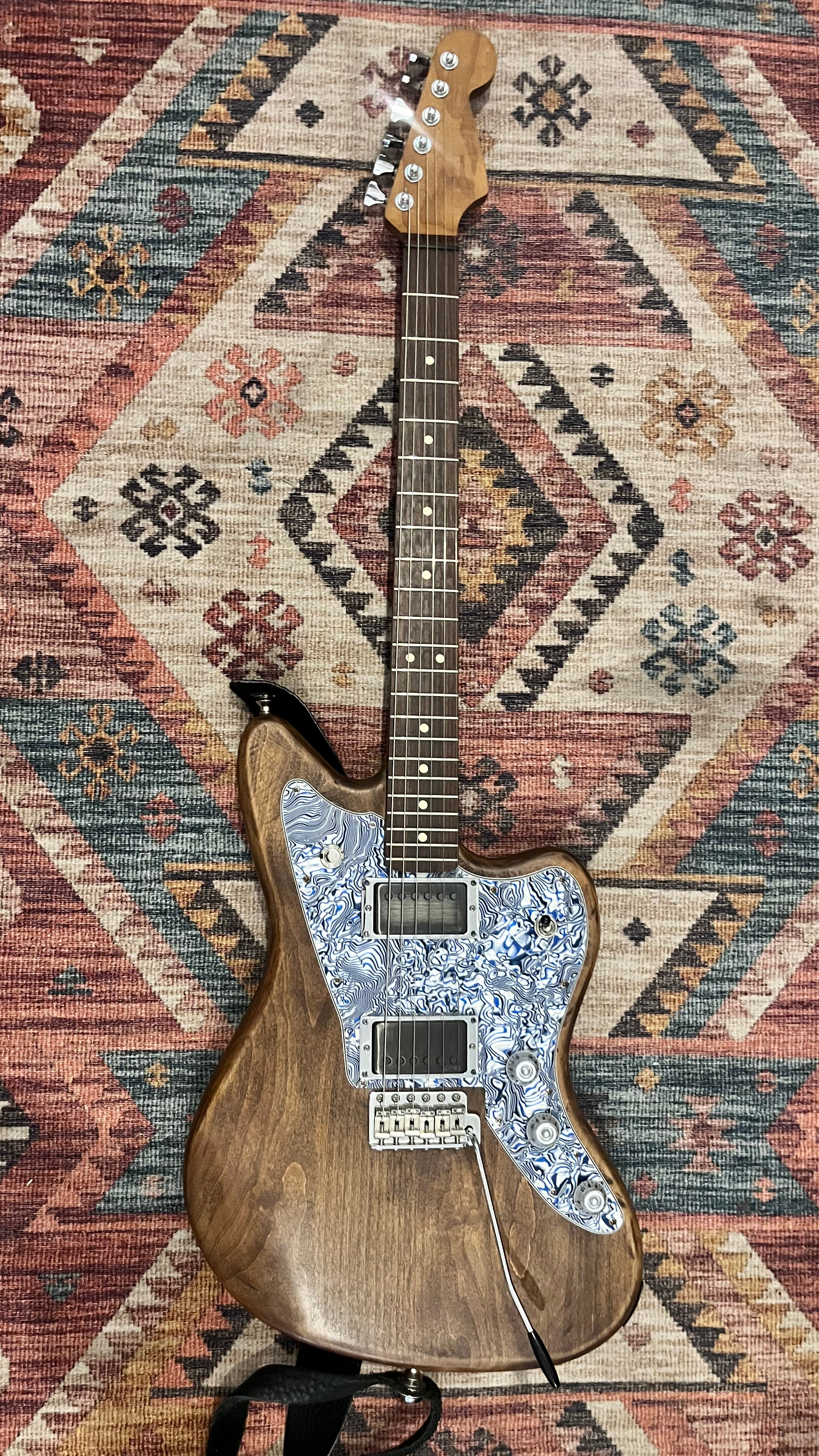
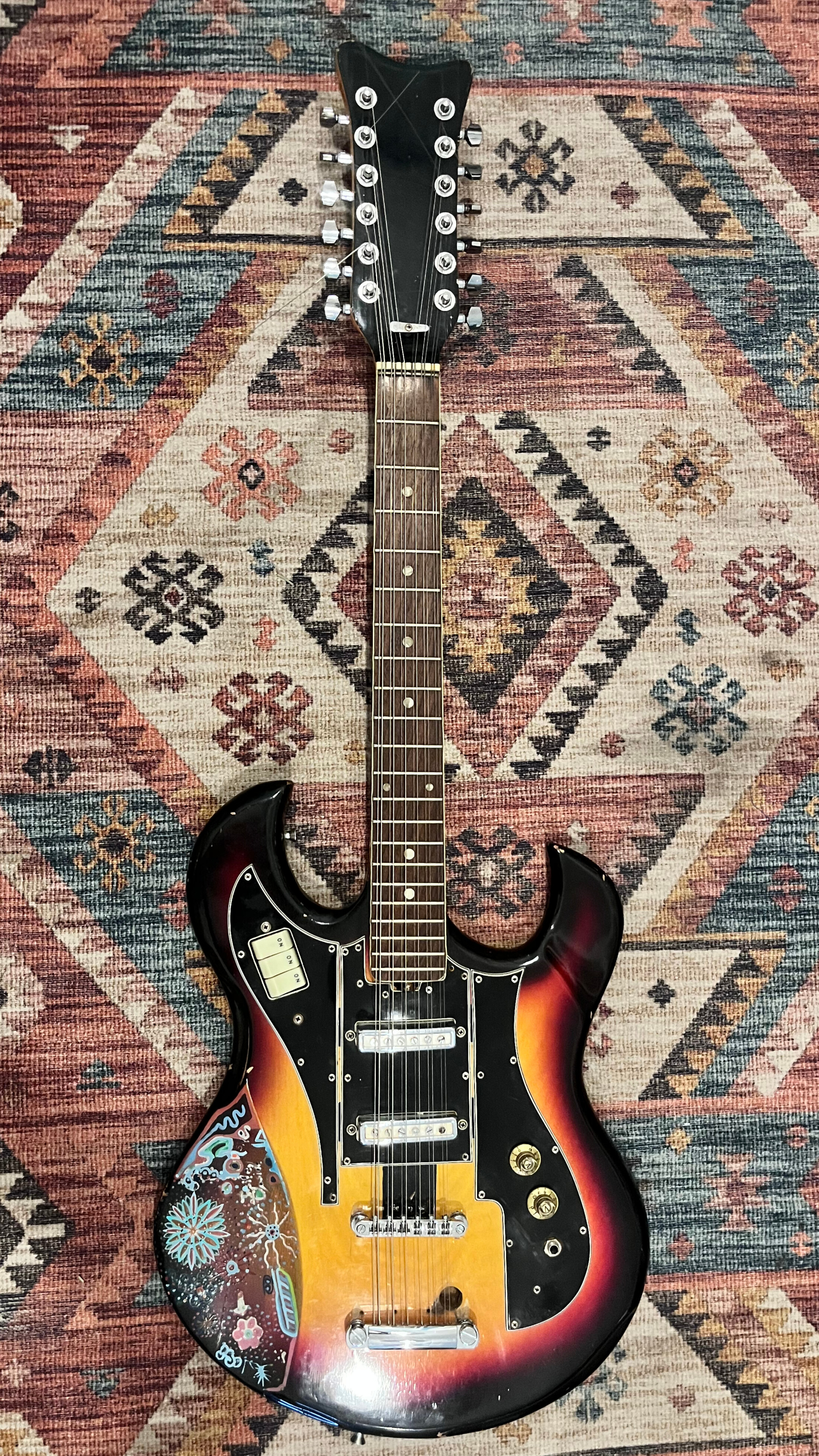
I really like music. I have a permanent headphone dent that is probably working it's way to my brain, but I wouldn't have it any other way. I have played guitar since 2016, and have been dabbling with music production since 2018. While my theory could be better, I am confident in my abilities across many genres. I've built a guitar, guitar pedals, and my own portable Acid House studio. (Yes that is a baking tray).
Art and projects
I like having a project to work on, something that keeps me daydreaming. I'm no artist, but I'll be damned if I stop trying.
Cooking
I have a gym goer, which is really just an excuse to more food. I am incredibly experimental with what I cook and decided my own social media page to encourage myself to get better at cooking AND music production. The account, Piggy Want Slop, documents my weekly meal prep efforts, where I try to make a song while I cook. I am proud to say that while the songs are often “experimental” and the meals avante-garde, this project has helped me sharpen my culinary skills and social media muscles. It's goofy, but it makes for good conversation.
A skill is only worth listing if it did something. Left: the skill. Right: what it actually did.
{{ s.name }}
{{ s.did }}
- {{ li }}
“Zac of all trades, and master of some”
About
I am Zac Spain. I am a recent Business Administration graduate of Cal Poly SLO, with a concentration in Marketing. I am looking for a full-time position in Marketing/Sales.
Experience
{{ job.role }}
{{ job.dates }}
{{ job.subtitle }}
{{ job.body }}
Diversions
{{ d.name }} — {{ d.body }}
Background
During June of 2024 I was given the extraordinary opportunity to manage my very own iPhone repair company: SLO iPhone Repair. One of my friends had been managing the business, but wouldn't be able to continue doing so after his eventual graduation. So I took over the business, and the rest is history.
The research stage
While business was good, I found the inconsistent sales volume to be problematic. Demand was surprisingly seasonal, and highly dependent on student activities. Because of this I decided to create a marketing campaign for the brand, and simplify other business activities. I began by conducting market research and analyzing my sales data.
I was able to gain two important insights from the data. Firstly, sales seemed to be the lowest around the months when students were gone, so I should focus my marketing efforts on them as opposed to my other segments. Second, I discovered that the iPhone 11s were generating the most revenue, so I should always have extra stock of that model.
From here I conducted more market analysis on my competitors and found two main opponents. The slides below show my analysis of them and where they fit in.
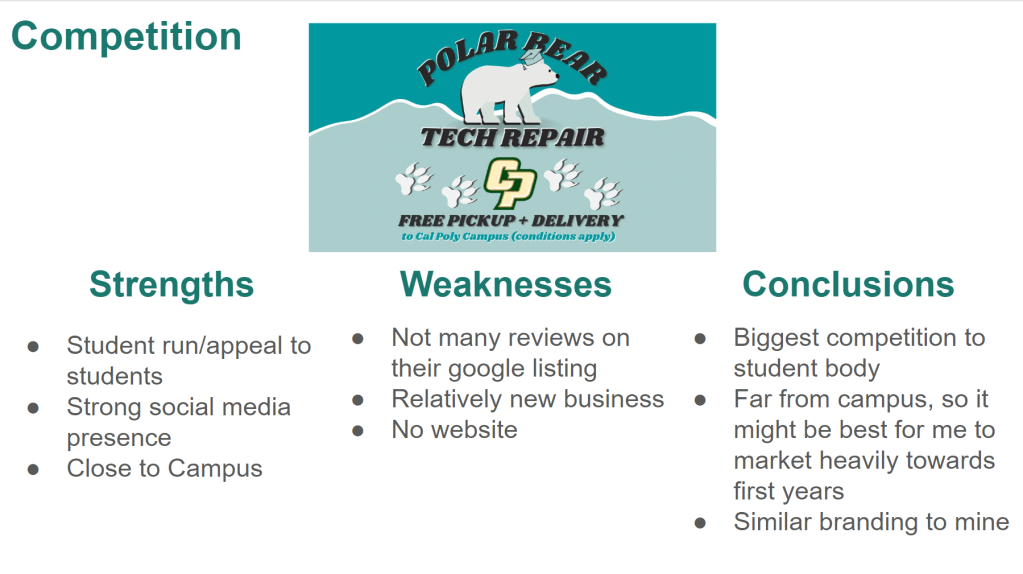
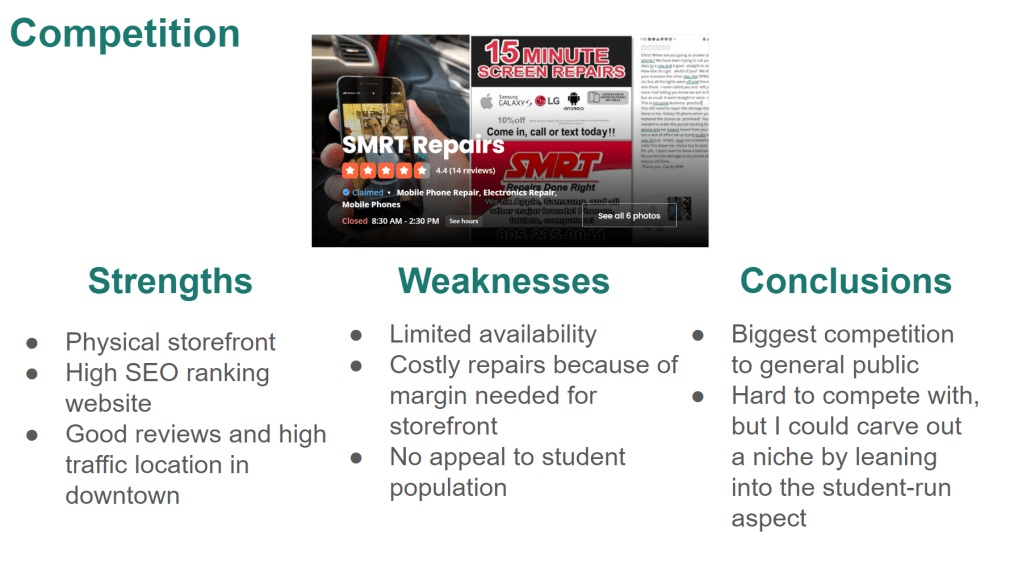
After analyzing these competitors, I realized that my target consumer were Cal Poly students, especially those who lived on campus. Because I ran the business out of my house right next to campus, a first year could walk to me, not to mention the SEO benefits of close proximity.
The rebrand and campaign
Once I knew my place in the local market and what strategies would work, I created a plan: build an official website, create a strong brand template, produce video ads for students, and improve my own quality of life as a manager and repair technician.
Website creation
The website was a huge success, and added an easy way to legitimize the business and answer questions customers had. The FAQ section reduced calls about services I didn't offer, and the about page put a face to the brand. The most useful feature was the automatic appointment scheduler I built on a Google Form, which set appointments up without me fielding calls in class. I also ranked on the front page of Google for iPhone repairs in San Luis Obispo, which hugely benefitted my volume. slophonerepair.com
Brand template
I created my own logo and brand language for the website. I mirrored the Cal Poly school colors as closely as possible to appeal to students — admittedly riding on their brand's coattails. I also made my own business card to hand to customers in the hope they'd pass it to friends.
Ad campaign
This was the real meat and potatoes of the project. The plan was short videos posted to the Cal Poly Snapchat story, which any student can post to and see. Most people skip past an ad on that surface, so the ads had to be sneaky — shot to look like the average post on the platform to reel students in.
Ultimately I am happy with how these ads turned out, and I believe they benefitted the brand's presence on campus.
Quality of life improvements
Besides the appointment calendar, I created a customer outreach plan and began tracking inventory more closely. I reached out to negative reviews to try to right them, or at least appear more active on the platform, and set reminders to reorder whenever a sheet detected I was low on a certain model.
Results
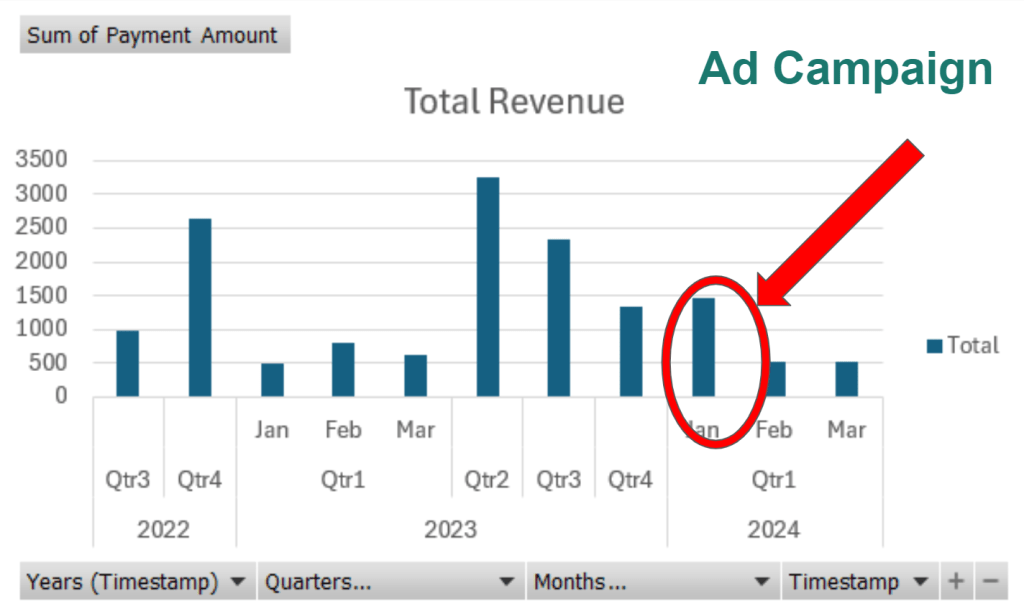
Overall the campaign was a success. During the month the initial ads aired in January, my revenue was triple what it normally was that month the year before. While revenue eventually tapered back off, I still greatly benefitted from the rebrand and QOL improvements in the following months. I learned a lot about marketing through this campaign, and am proud to have applied my own touch to the business.
During Fall of 2022 I was part of a marketing group helping the Cambria Scarecrow Festival gain more attendees. For this project I created a survey sent to all of their past attendees in an attempt to discover the festival's target market. Below is the report on my analytical findings.
I was part of a team tasked with conducting market research for Cal Poly Housing to discover whether they should create more on-campus housing for students. My team and I worked closely with members of the student population and the Housing board in order to discover what would be best for the school. Below is our final report.

Research & Analytics · Launches & campaigns · Systems optimization · Conversation Starters · Skills and Certifications